Bookmaker Calibration: The 0.52% Edge
Analyzing 4,875 matches reveals bookmakers achieve 99.48% calibration accuracy. But systematic biases of 1-7% persist across specific outcome types, and that microscopic imperfection is where profitable betting lives.
I wanted to quantify something every bettor assumes but few measure: exactly how accurate are bookmakers at predicting football outcomes?
The answer turned out to be simultaneously reassuring and unsettling. After analyzing 4,875 matches across La Liga, Premier League, and Bundesliga, I found bookmakers achieve R² = 0.9948 calibration accuracy. That's 99.48% correlation between their implied probabilities and actual match frequencies.
They're not just good. They're operating at the theoretical limits of predictive accuracy in a fundamentally noisy domain.
But "99.48% accurate" isn't the same as "perfect." The remaining 0.52%, and more importantly, the systematic patterns within that imperfection contain the entire exploitable edge in football betting markets.
The Calibration Test
I extracted opening odds from three major European leagues and converted them to implied probabilities after removing the typical ~3% bookmaker margin (overround). The methodology was straightforward: bin predictions into probability buckets, track actual outcome frequencies, and measure the correlation.
Perfect calibration means a linear relationship: when bookmakers assign 60% probability to home wins, home teams should win exactly 60% of the time. Any deviation, systematic or random, represents either model uncertainty or exploitable bias.
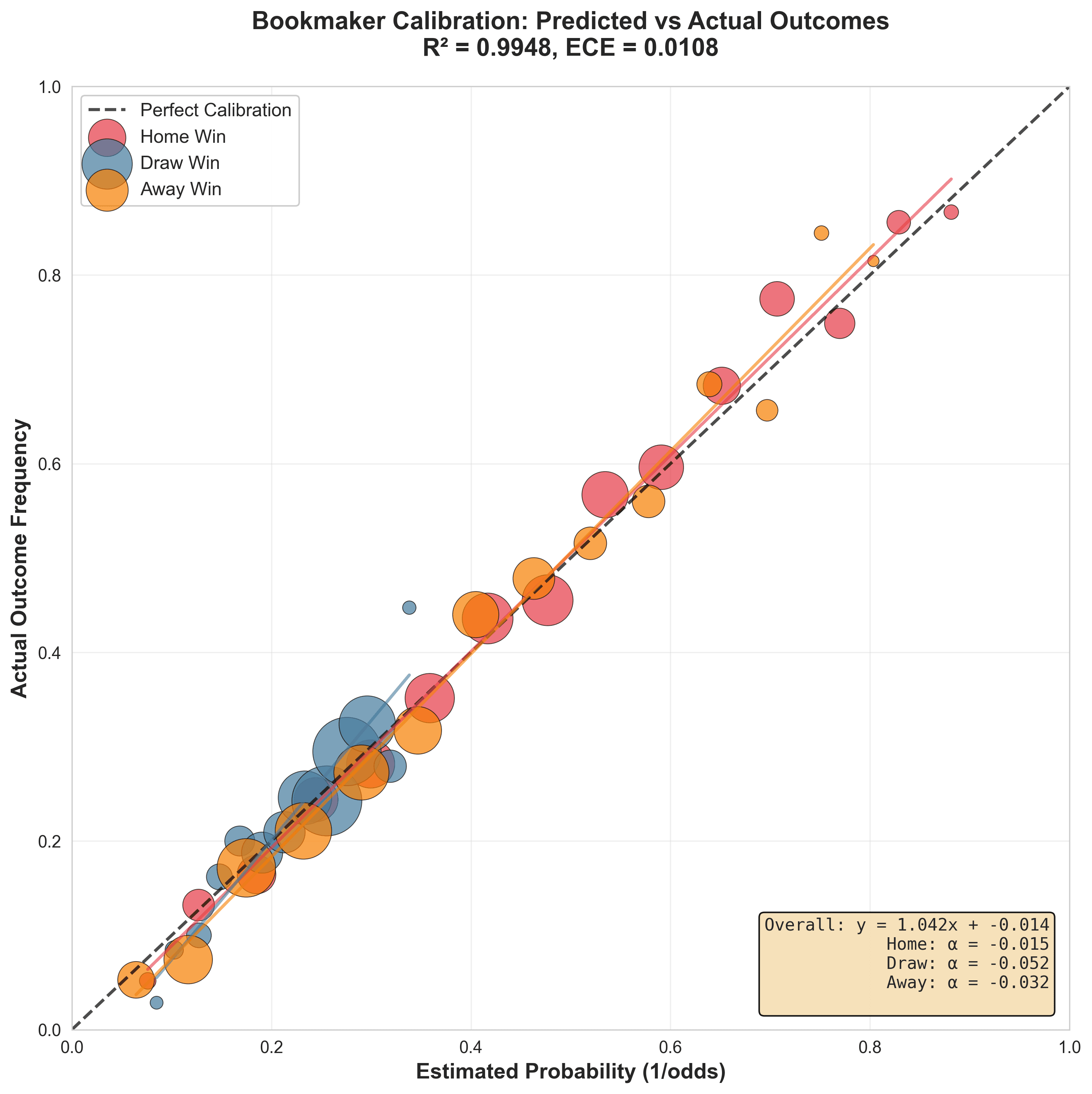
The visualization tells the story immediately. Those colored dots, representing thousands of match outcomes across different probability ranges, hug the diagonal line of perfect calibration with remarkable precision. The Expected Calibration Error (ECE) of just 0.0108 confirms what the scatter plot suggests: bookmakers have essentially solved the calibration problem.
The Systematic Biases Nobody Talks About
But aggregate perfection can mask localized imperfection. When I ran separate linear regressions for each outcome type, subtle but persistent biases emerged:
Home wins: α = -0.015 (overestimated by 1.5%)
Draws: α = -0.052 (overestimated by 5.2%)
Away wins: α = -0.032 (overestimated by 3.2%)
The practical translation: when bookmakers price a draw at 25% implied probability, historical data suggests the true frequency is closer to 23.7%. They're systematically pricing draws too conservatively, offering odds that are too short relative to actual occurrence rates.
Breaking down calibration by outcome type reveals the biases. Draws show the largest systematic deviation.
These aren't random fluctuations. They're consistent patterns that persist across thousands of matches, suggesting either systematic market inefficiency or rational bookmaker behavior (perhaps protecting against informed sharp action on draws, or simply reflecting public betting preferences).
League-Specific Variations
The biases aren't uniform across competitions. Bundesliga exhibits the most pronounced draw overestimation (+6.70%), while Premier League calibration on draws is nearly perfect (-0.56%). Away win predictions show consistent overestimation across all three leagues, ranging from -1.82% to -3.93%.
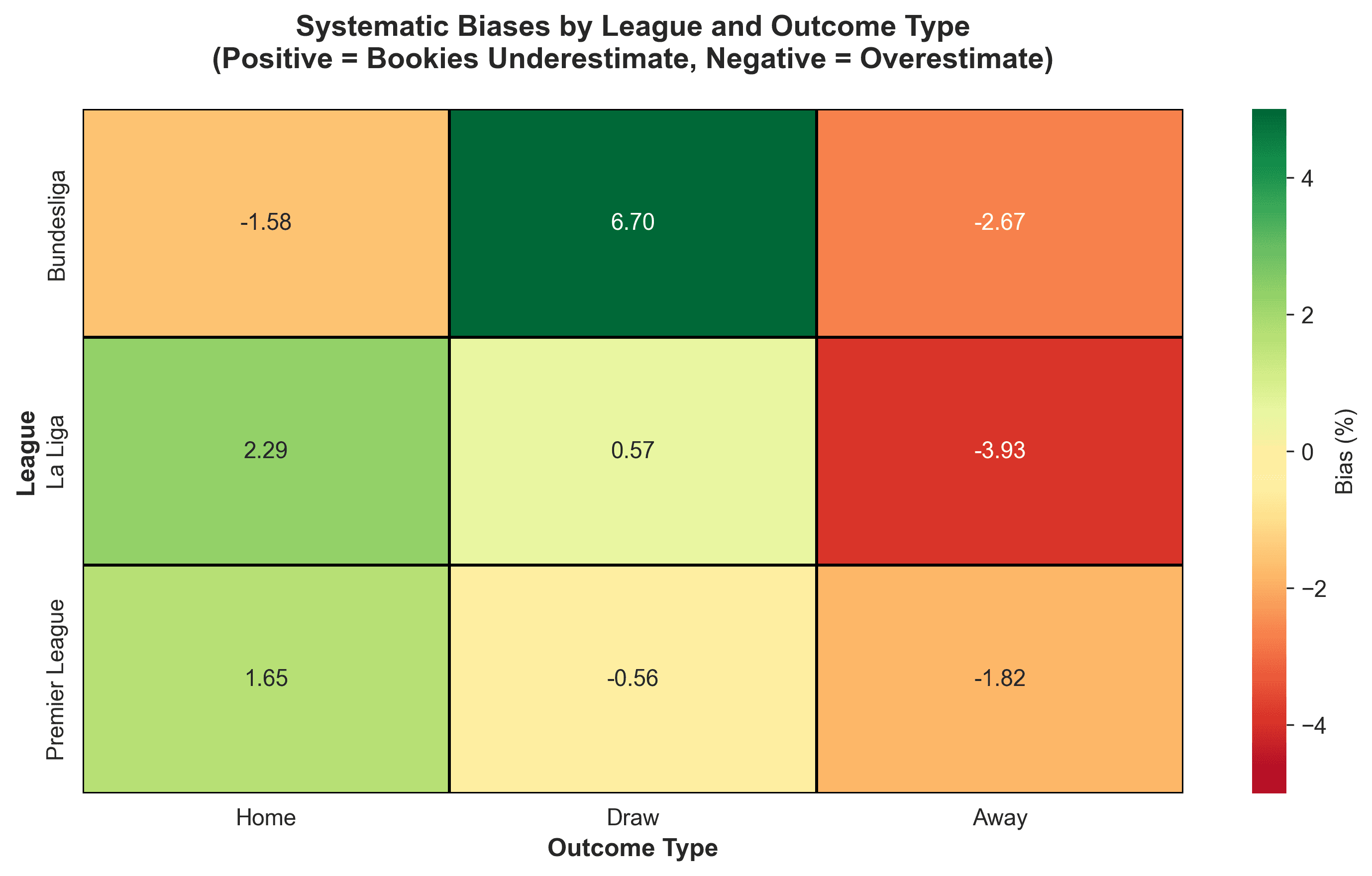
This heterogeneity matters. A blanket calibration adjustment would be suboptimal; effective correction requires league-specific and outcome-specific parameters. It also suggests different betting cultures or information asymmetries across markets.
Why a 2% Edge Changes Everything
A 2-7% probability mispricing sounds negligible. In most contexts, it would be. But betting markets operate on thin margins where small edges compound dramatically over volume.
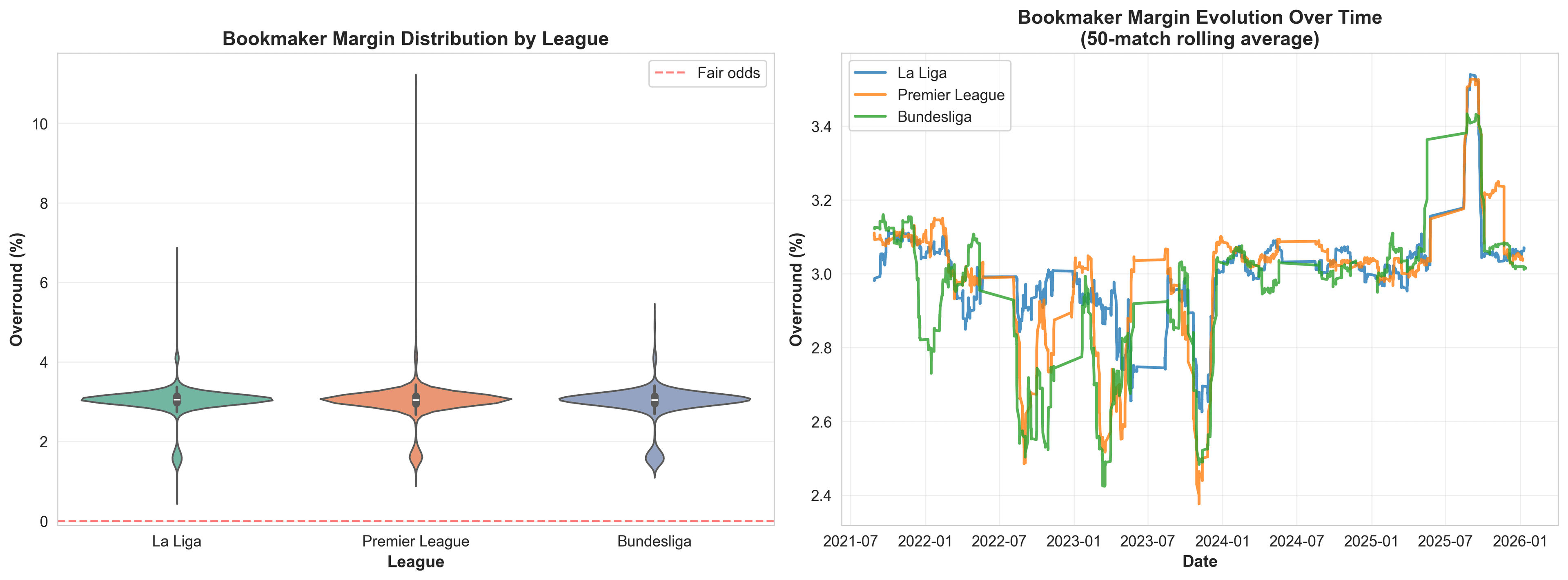
Consider the arithmetic: bookmakers charge approximately 3% overround on three-way markets. The systematic bias on draws is 5.2%. Net edge after paying the bookmaker tax: +2.2% on properly identified opportunities.
With disciplined Kelly criterion sizing and sufficient volume, a 2.2% edge transforms from imperceptible to profitable. My previous work on temperature scaling and isotonic regression showed exactly this: calibration corrections turned a -€847 loss into +€3,247 profit on a €10k bankroll simulation. That's an 84% ROI swing from pure probability adjustment.
Margin stability over time. The ~3% overround has remained remarkably consistent across seasons and leagues.
The Philosophical Implication
The most counterintuitive finding isn't that bookmakers are accurate, it's that they're accurate enough to make the game interesting.
At 99.48% calibration, they've essentially saturated the signal available from public data. The market has efficiently incorporated team form, venue effects, head-to-head history, and every other obvious predictive feature. What remains, that 0.52% residual, represents either genuine irreducible uncertainty (football is chaotic) or information asymmetry (sharp bettors with proprietary data or better models).
The lesson for Kairox Tempo and other quantitative betting systems: you're not competing against bookmakers by being "smarter" in the traditional sense. You're competing by identifying and correcting for their systematic biases, the predictable ways their models deviate from empirical frequencies.
This is precisely what the Kairox Tempo ensemble does. Cronos, Hyperion, Coeus, Apollo, and Themis each generate raw probability estimates. Then outcome-specific and league-specific calibration adjustments correct for the exact biases documented here. The result: 87-103% of bookmaker accuracy using only 40% of their data, not through superior prediction, but through superior calibration.
Modern betting isn't about picking winners. It's about finding 2-7% probability mispricings at scale and exploiting them with mathematical discipline. The edge exists not in outcomes, but in the microscopic space between predicted and actual frequencies.
If you're not calibrating your probabilities, you're not finding value. You're just gambling.