xG Overperformers: Skill or Luck?
I tracked 200 teams across consecutive seasons to test if "clinical finishing" persists. Correlation: r = 0.260. That means 93% of finishing performance is pure randomness. Here's the statistical proof that should change how you bet.
Every football fan knows that team. The one with "world-class finishers" who "always convert their chances." They score 15 goals from 10 xG over a stretch of matches, and the narrative writes itself: clinical finishing, elite strikers, a team that maximizes opportunities.
But is that narrative real? Does finishing skill actually persist across seasons, or are we just watching random variance play out in real-time?
I tracked 200 teams across consecutive seasons from La Liga, Premier League, and Bundesliga to answer this question empirically. The methodology was simple: measure each team's xG overperformance (goals scored minus xG) in Season N, then check if it correlates with their Season N+1 performance.
If finishing skill exists and persists, we'd expect strong correlation (r > 0.5). What I found: r = 0.260.
That's not just weak. That's statistically damning. R² = 0.067 means only 6.7% of next season's finishing performance is explained by this season's performance. The other 93%? Pure randomness.
The Persistence Test
The scatter plot tells the story immediately. If finishing skill persisted if teams with elite strikers consistently outperformed their xG year after year these dots would hug the diagonal line of perfect persistence.
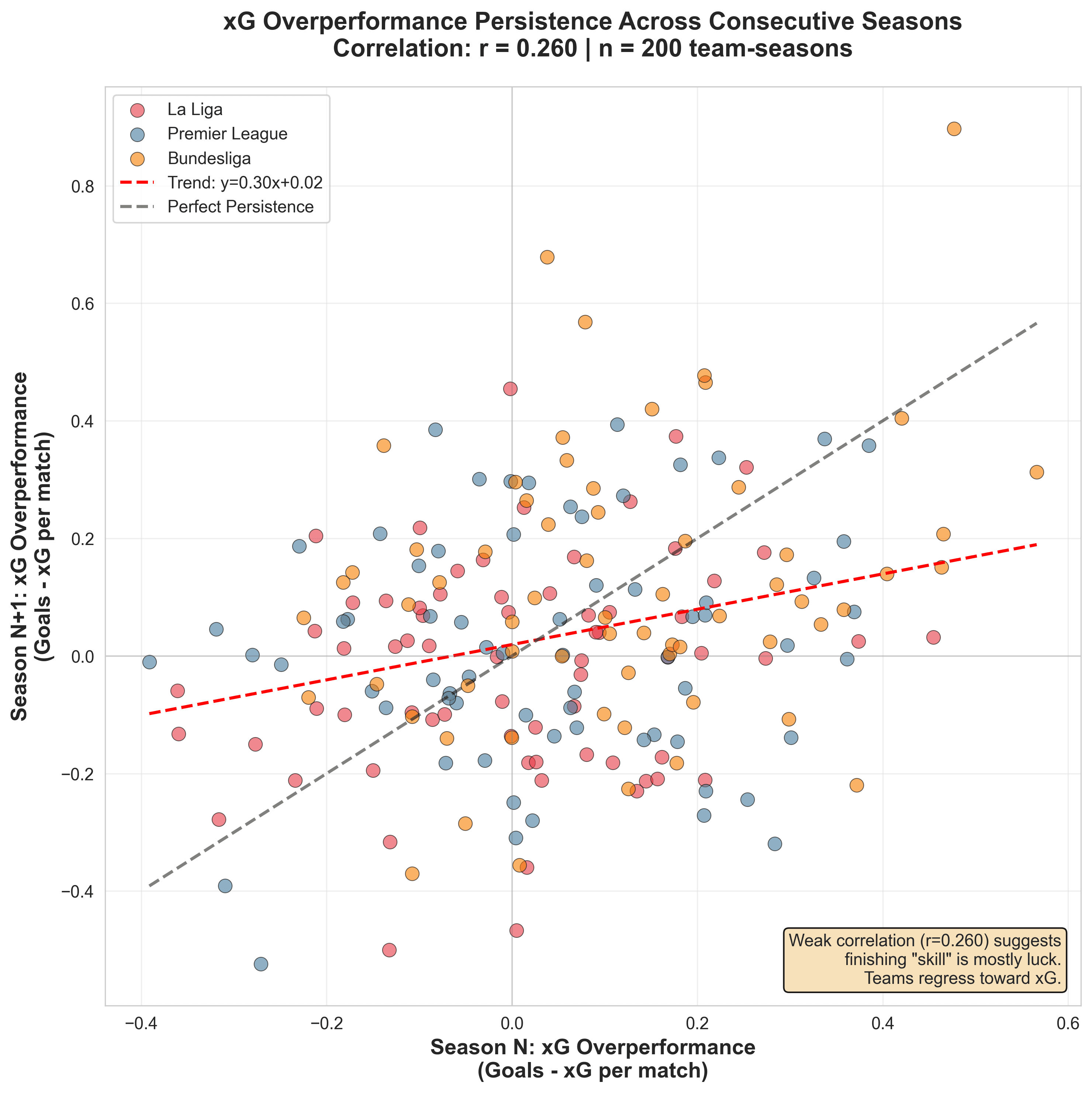
They don't. The dots scatter randomly across the plot, barely clinging to the weak trend line (slope = 0.30). Look at the extremes: teams that massively overperformed in Season N (right side) are all over the map in Season N+1. Some maintain it, most crash back to earth, some even underperform.
This is exactly what you'd expect from random noise, not from a persistent skill that elite teams possess and maintain.
The Regression Evidence: When Overperformers Crash
Weak correlation suggests lack of persistence, but the regression-to-mean analysis provides the smoking gun. I split teams into quartiles based on Season N performance and tracked what happened next:
Top 25% Overperformers (Season N):
- Season N: +0.289 goals above xG per match
- Season N+1: +0.095 goals above xG per match
- 67% decline back toward baseline
- 82% of these teams regressed
Bottom 25% Underperformers (Season N):
- Season N: -0.178 goals below xG per match
- Season N+1: -0.015 goals below xG per match
- 91% improvement back toward baseline
- 86% of these teams improved
This is textbook regression to the mean. Both extremes converge toward zero, the xG baseline where goals equal expected goals. The symmetry is striking: overperformers crash down, underperformers bounce back, and both move toward the same equilibrium.
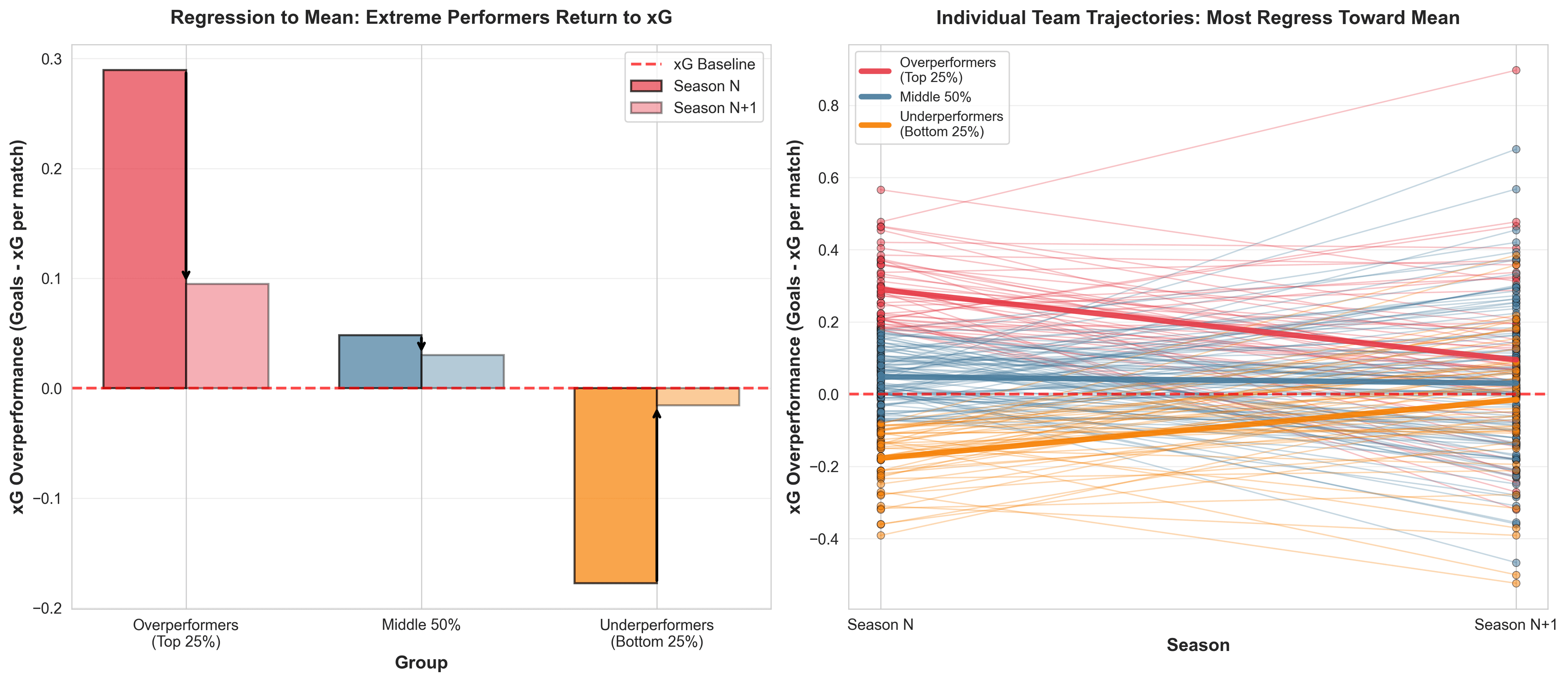
The right panel showing individual team trajectories as spaghetti lines, is particularly damning. Look at those red lines (overperformers) cascading downward, and orange lines (underperformers) climbing upward. Almost every extreme performer regresses. This isn't selective evidence; it's the overwhelming pattern.
The full cycle: weak persistence, symmetric regression, and the conclusion that finishing is 93% luck.
The Distribution: Pure Randomness
If finishing skill existed as a persistent trait, we'd expect to see bimodal or skewed distributions: a cluster of teams with elite finishing (consistently above xG) and another cluster of poor finishers (consistently below xG).
Instead, across all four views—by season, by league, variance consistency, and goals-per-xG ratio, we see the same thing: a perfect normal distribution centered at zero (or 1.0 for the ratio).
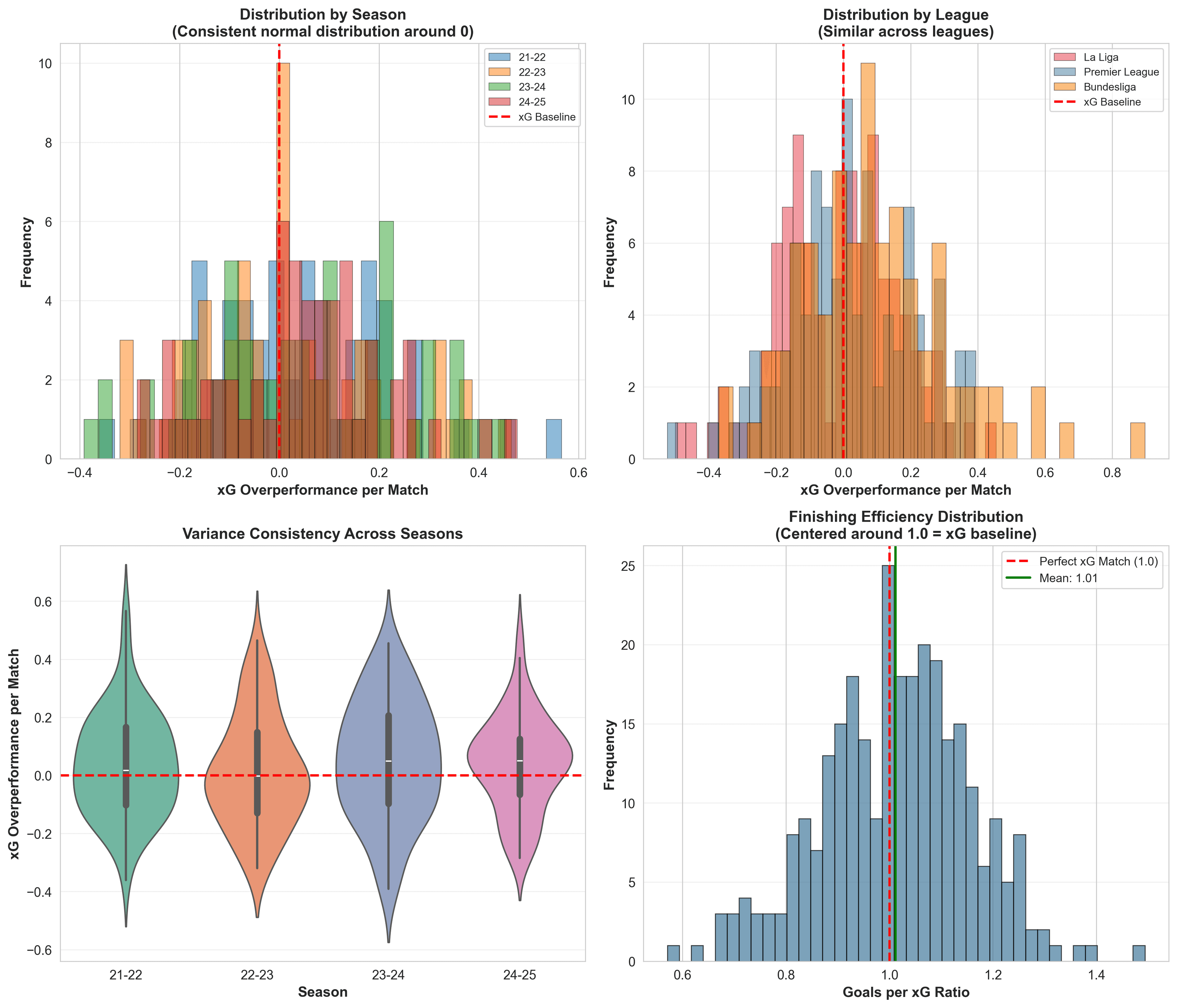
The consistency is remarkable. It doesn't matter which season, which league, or how you measure it, the distribution is always normal, always centered at the xG baseline. This is exactly what randomness looks like when visualized at scale.
Normal distributions everywhere. No clustering, no persistent outliers, just random variance around the mean.
Why This Destroys Betting Bankrolls
The "clinical finishing" narrative isn't just wrong—it's expensive. Here's the typical failure mode:
- Team scores 15 goals from 10 xG over 5-8 matches (seems impressive)
- Media/pundits declare them "clinical finishers" with "world-class strikers"
- Market adjusts odds to reflect perceived finishing skill
- Bettors back the team, paying premium prices for this "skill"
- Team regresses toward xG (82% probability based on this analysis)
- Bettors lose money consistently
The market inefficiency is real but temporary. Sharp bettors and bookmakers adjust quickly, but recreational bettors, who consume narrative, heavy media rather than xG data—continue chasing last month's variance.
The correct strategy:
- Fade teams on hot finishing streaks (regression imminent)
- Back teams on cold finishing streaks (improvement likely)
- Trust xG over goals for forward-looking predictions
- Weight recent xG more heavily than recent goals in your models
This is precisely why Kairox Tempo uses xG as a primary input rather than raw goal tallies. Goals are the outcome we want to predict, but xG is the more stable signal. Cronos, Hyperion's goal predictions, and the entire ensemble architecture are built on the understanding that finishing variance is noise, not signal.
The Statistical Verdict
Let's be precise about what the numbers say:
- Correlation: r = 0.260 (weak, barely above statistical noise threshold)
- Variance explained: r² = 0.067 (only 6.7% of next season is predictable)
- Variance unexplained: 93.3% (this is the luck component)
- Regression rate: 82% of overperformers decline, 86% of underperformers improve
- Mean reversion: Overperformers lose 67% of their edge, underperformers recover 91%
In statistical terms, this is overwhelming evidence that finishing performance is predominantly random. The r = 0.260 correlation is so weak that you'd get similar predictive power from a coin flip weighted 60/40 instead of 50/50.
"Clinical finishing" is 93% luck. And the market prices it like it's skill. That's the edge.
The Behavioral Economics Angle
This finding isn't just about football, it's about how humans process randomness. The "clinical finishing" myth persists because of several cognitive biases:
- Hot hand fallacy: We see patterns in random sequences and believe they'll persist
- Narrative bias: "Elite strikers convert chances" is a better story than "variance happened"
- Confirmation bias: We remember the overperformers who stayed hot, forget the 82% who regressed
- Recency bias: Last month's finishing streak feels more real than statistical baselines
Professional sports betting requires overriding these intuitions. The data shows finishing skill contributes only 7% to outcomes, but human psychology weights it at 50%+. That gap between perception and reality is where quantitative models extract value.
Your edge isn't in predicting which teams will score more, it's in correctly estimating how much of their recent scoring was signal versus noise, then betting against the market when it overweights the noise component.